
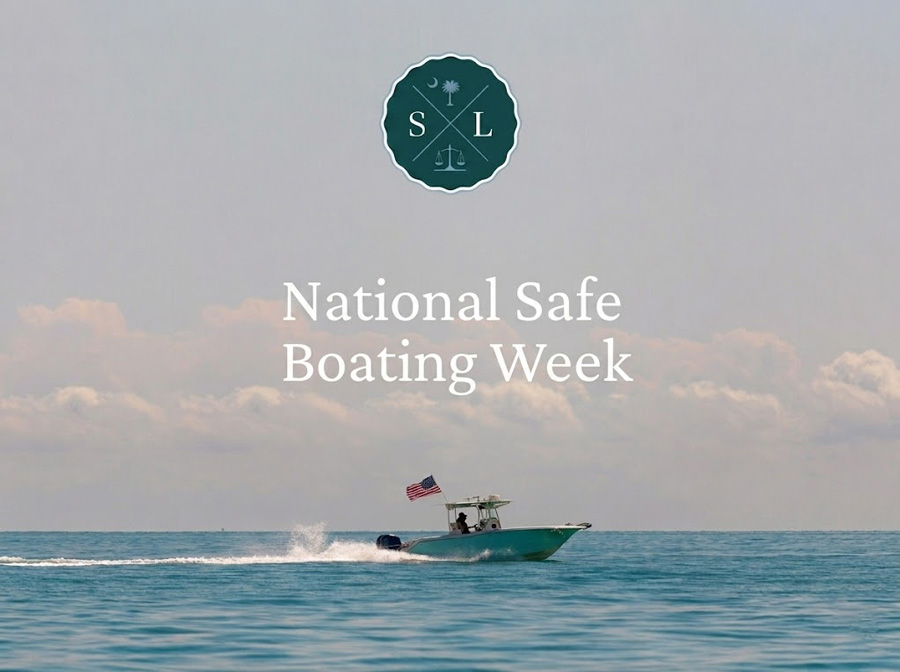
Here in the Lowcountry, life on the water is part of who we are. From fishing trips, sandbar days, tubing and wakeboarding, exploring, and sunset cruises, boating is one of the best things about living in South Carolina.
As we recognize National Safe Boating Week (May 16–22), it’s a great time to remember that a little preparation goes a long way toward keeping everyone safe this spring and summer. Many folks move here with boating experience, but are not familiar with our tides, currents, and hidden obstacles such as oyster beds, mudbanks and sandbars. It is important to plan ahead, read your charts, have a plan, and always take a few basic precautions before any water adventure. Others are brand new to boating. The Lowcountry is beautiful but can be challenging to navigate, especially when everyone wants to be on the water.
So, please consider a few simple safety reminders BEFORE heading out on the water:
- Make sure you have properly fit Coast Guard approved PFDs (personal floatation devices aka life jackets) for you and each of your passengers and at least one throwable PFD device.
- Remember, all children under the age of 12 must wear an approved PFD whenever a boat is underway
- Always check weather and water conditions before leaving the dock.
- Make sure that you have an operational horn or handheld horn and safety whistle.
- Keep emergency flares on board (check their expiration date!).
- Make sure your equipment is operational, including navigation lights, navigation devices, VHF radio, and bilge pumps.
- Bring plenty of water for you and your passengers in the event of a breakdown.
- Bring sun protection and extra cover in the event of an emergency or long stranding.
Once you are on the water, remember these important “Rules of the Road” (or more appropriately, “Rules of the Water”):
- Keep a safe speed—you must operate your vessel at a speed that avoids collisions with other vessels.
- Give Way or Stand On?: The rule is the boat to your right is the “Stand On Vessel.” This means that, when crossing paths with another boat, if the boat is on your right side (the starboard side), you are the Give Way vessel and you must give way to the Stand On vessel (when driving a car, we call this the right of way). This is why navigation lights on boats are red on the port (left side) and green on the starboard (right side). When you see a red navigation light on a vessel at night, that means that they are the Stand On vessel and you must Give Way (yield) to them.
- Passing or Meeting Head On: The rule is to turn right (Starboard) and pass Port to Port (left to left side, the same way we operate motor vehicles in the United States).
- Overtaking: If you pass another boat, you must do so at a safe distance so as not to interfere with the overtaken boat’s navigation (don’t force the boat to change course, or “wake out” the overtaken boat.
- Yield to Boats Under Sail: As a general rule (with few exceptions) power driven boats must yield to a boat which is under sail and to boats being paddled.
- Maintain a safe distance: Never operate a boat within 50 feet of another boat, swimmer, dock or pier unless you are at a safe idle speed.
- No Wake Zone and Bridges: Do not exceed idle speed within any designated no wake zone, under bridges, within 50 feet of a dock, pier, or any diver down flag. Larger recreational vessels often slow to the point where they believe they are at idle but instead are above idle putting out a large wake. This is incredibly dangerous for dock and fuel operations and often causes property damage can cause personal injury. Mind your wake in no wake zones and slow down.
- “Last best chance”: Even if someone else is failing to follow the “Rules of the Water” you still hold the obligation to take action to avoid a collision if possible. Do not be stubborn and unnecessarily put yourself at risk when you can take measures to avoid a collision even if someone else is breaking the rules. If you would like to read more regarding this fundamental rule, see here is a link to 33 CFR§ 83.08 (known as “Rule 8”) https://www.law.cornell.edu/cfr/text/33/83.08
- Law Enforcement: If law enforcement signals you, immediately stop and follow their instructions.
- Avoid distracted or impaired boating—just like operating a motor vehicle, it is illegal to operate a boat under the influence in South Carolina.
- Always keep a proper lookout
- Share your float plan (your destination and expected time of return) with someone you trust, particularly if you are going out on an offshore fishing trip or long inshore run.
Unfortunately, boating accidents are often a result of people not following these basic Rules of the Water. Boating accidents can cause devastating personal injury to passengers and others, and result in expensive property damage. Taking a proactive approach to safety helps protect not only you and your passengers, but everyone enjoying our waterways.
Your Rights and Obligations in the event of an accident:
If you do find yourself in an accident, you (and the other vessel owner and operator involved in the collision) are required to report the accident to the SC Department of Natural Resources within 48 hours if the accident involves medical treatment other than minor first aid, involves the loss of life or significant property damage. The precise definition of a “Reportable boating accident” is contained in S.C. Code Section 50-21-10 (21). (“ “Reportable boating accident” means an accident, collision, or other casualty involving a vessel subject to this chapter which results in loss of life, injury which results in loss of consciousness, necessity for medical treatment, necessity to carry a person from the scene, disability which prevents the discharge of normal duties beyond the day of casualty, or actual physical damage to property including vessels in excess of the minimum amount set by the United States Coast Guard for reportable accidents”).
The operator of a boat that is in an accident is required to render assistance as may be practical or necessary to persons affected by the collision accident or other casualty, and give their name, address and identification of your vessel to any person who is injured in the accident and the owner of any other boat involved in an accident so long as rendering aid does not place yourself, vessel or passengers in serious danger. Failing to do so is crime in South Carolina.
If you are injured or suffered damage in a boating accident that was not your fault
- Make sure that you obtain the name of operator of the other boat and the owner of the other boat, the other boat’s VIN (identification number), and a copy of their insurance, if they have insurance.
- Make sure that the accident is reported to the South Carolina Department of Natural Resources. In the case of an emergency, call 911 and radio for help on Channel 16 of your VHF.
- Get the medical treatment you need as soon as possible.
- Contact an attorney to make sure that your rights are protected and to ensure that the matter is properly reported to SCDNR.
At Shelton Law Firm, we’re proud to serve the Lowcountry community both on and off the water. We hope everyone has a safe and enjoyable boating season ahead.
And, if you or a loved one ever need guidance following boating accident or injury in South Carolina, our team is here to help.